Thursday, May 30, 2013


    This is Rose Valland, one of the heroes of Nazi-Occupied France. An employee of the Louvre, she kept records of the art stolen by Nazi officers—what was taken, from where, and by whom. She was instrumental in the postwar return of countless stolen pieces, and one of the most decorated women in French history.

Géricault's Portraits of the Insane 

After The Raft of the Medusa
At the end of 1821 the leading Romantic painter in France, Théodore Géricault, returned from a year long stay in England where crowds had flocked to see his masterpiece The Raft of the Medusa displayed in the Egyptian Hall in Pall Mall, London. Despite the success of the exhibition, the French government still refused to buy the painting and his own prodigious spending meant that he was strapped for cash and in no position to embark on another ambitious and expensive large scale project like The Raft. His health too was soon to suffer. On his return to France, a riding accident led to complications, causing a tumor to develop on the spine that proved fatal. He died, aged 32, in January 1824.

Géricault, Portrait of a Woman Addicted to Gambling, 1822, Oil on canvas (Musée du Louvre, Pari)sPerhaps the greatest achievement of his last years were his portraits of the insane. There were ten of them originally. Only five have survived: A Man Suffering from Delusions of Military Command; A Kleptomaniac; A Woman Suffering from Obsessive Envy; A Woman Addicted to Gambling and A Child Snatcher.
No information is available for those that have been lost. According to the artist’s first biographer, Charles Clément, Géricault painted them after returning from England for Étienne-Jean Georget (1795-1828), the chief physician of the Salpêtrière, the women’s asylum in Paris. The paintings were certainly in Georget’s possession when he died.
Théodore Géricault, Portait of a Woman Suffering from Obsessive Envy (The Hyena), 1822, oil on canvas, 72 x 58 cm (Musée des Beaux-Arts, Lyons)

Three Theories for the Commission
How the two men met is not known for sure. Possibly Georget treated Géricault as a patient, or perhaps they met in the Beaujon Hospital, from whose morgue Géricault had taken home dissected limbs to serve as studies for his figures in The Raft. What is more debated though, is Georget’s role in the production of the paintings. There are three main theories. The first two link the portraits to the psychological toll taken out of Géricault whilst producing his great masterpiece and the nervous breakdown he is believed to have suffered in the autumn following its completion in 1819. The first theory runs that Georget helped him to recover from this episode and that the portraits were produced for and given to the doctor as a gesture of thanks; the second puts forward that Georget, as the artist’s physician, encouraged Géricault to paint them as an early form of art therapy; and the third is that Géricault painted them for Georget after his return from England to assist his studies in mental illness.
It is this last that is generally held to be the most likely. Stylistically, they belong to the period after his stay in England, two years after his breakdown. Also, the unified nature of the series, in terms of their scale, composition and color scheme suggest a clearly defined commission, while the medical concept of “monomania” shapes the whole design. 

Géricault, Portrait of a Man Suffering from Delusions of Military Command, 1822, oil on canvas (Sammlung Oskar Reinhart, Winterhur)Early Modern Psychiatry
A key figure in early modern psychiatry in France was Jean-Etienne-Dominique Esquirol (1772-184), whose main area of interest was “monomania,” a term no longer in clinical use, which described a particular fixation leading sufferers to exhibit delusional behavior, imagining themselves to be a king, for example. Esquirol, who shared a house with his friend and protégé Georget, was a great believer in the now largely discredited science of physiognomy, holding that physical appearances could be used to diagnose mental disorders. With this in mind, he had over 200 drawings made of his patients, a group of which, executed by Georges-Francoise Gabriel, were exhibited at the Salon of 1814. As an exhibitor himself that year, it seems highly likely that Géricault would have seen them there.

Théodore Géricault, Portrait of a Man Suffering from Delusions of Military Command, 1822, oil on canvas, 81 x 65 cm (Sammlung Oskar Reinhart, Winterhur)
Georget’s work developed on Esquirol’s. An Enlightenment figure, he rejected moral or theological explanations for mental illness, seeing insanity, neither as the workings of the devil nor as the outcome of moral decrepitude, but as an organic affliction, one that, like any other disease, can be identified by observable physical symptoms. In his book On Madness, published in 1820, following Esquirol, he turns to physiognomy to support this theory,

In general the idiot’s face is stupid, without meaning; the face of the manic patient is as agitated as his spirit, often distorted and cramped; the moron’s facial characteristics are dejected and without expression; the facial characteristics of the melancholic are pinched, marked by pain or extreme agitation; the monomaniacal king has a proud, inflated expression; the religious fanatic is mild, he exhorts by casting his eyes at the heavens or fixing them on the earth; the anxious patient pleads, glancing sideways, etc.
The clumsy language here—“the idiot’s face is stupid”—seems a world away from Géricault’s extraordinarily sensitive paintings, a point that begs the question whether Géricault was doing more than simply following the good doctor’s orders in producing the series, but instead making his own independent enquiries.

Géricault, Portait of a Woman Suffering from Obsessive Envy (The Hyena), 1822, oil on canvas (Musée des Beaux-Arts, Lyon) Géricault had many reasons to be interested in psychiatry, starting with his own family: his grandfather and one of his uncles had died insane. His experiences while painting The Raft must also have left their mark. The Medusa’s surgeon, J.B. Henry Savigny, at the time Géricault interviewed him, was writing an account of the psychological impact the experience had had on his fellow passengers and, of course, there was Géricault’s own mental breakdown in 1819. It seems only natural then that he would be drawn to this new and exciting area of scientific study. 
Théodore Géricault, Portait of a Woman Suffering from Obsessive Envy (The Hyena), 1822, oil on canvas, 72 x 58 cm (Musée des Beaux-Arts, Lyons)
Alternatively, some critics argue that Géricault’s work is a propaganda exercise for Georget, designed to demonstrate the importance of psychiatrists in detecting signs of mental illness. In their very subtleties they show just how difficult this can be, requiring a trained eye such as Georget’s to come to the correct diagnosis. According to Albert Boime, the paintings were also used to demonstrate the curative effects of psychiatric treatment. If the five missing paintings were ever found, he argues, they would depict the same characters—but after treatment—showing their improved state, much like ‘before and after’ photographs in modern day advertising. 

This, of course, is impossible to prove or disprove. What is more challenging is Boime’s general criticisms of early psychiatry which, he argues, by classifying, containing and observing people was effective only in silencing the voices of the mentally ill, rendering them invisible and therefore subject to abuse. The fact that the sitters of the paintings are given no names, but are defined only by their illnesses would seem to confirm this view and, for that reason, many modern viewers of the paintings do feel disconcerted when looking at them. 

Géricault, Portrait of a Kleptomaniac, 1822, oil on canvas (Museum of Fine Arts, Ghent)The Portraits
The five surviving portraits are bust length and in front view, without hands. The canvases vary in dimensions but the heads are all close to life-size. The viewpoint is at eye level for the three men but from above for the women, indicating that the paintings were executed in different places. It seems likely that the women were painted in the women’s hospital Salpêtrière, while the men were selected from among the inmates of Charenton and Bicȇtre.

None of the sitters is named; they are identified by their malady. None look directly at the viewer, contributing to an uneasy sense of distractedness in their gazes that can be read as stillness, as though they are lost in their own thoughts, or as disconnectedness from the process in which they are involved. These are not patrons and have had no say in how they are depicted. 
Théodore Géricault, Portrait of a Kleptomaniac, 1822, oil on canvas, 61 x 50 cm (Museum of Fine Arts, Ghent)

Each is shown in three-quarter profile, some to the left, some to the right. The pose is typical of formal, honorific portraits, effecting a restrained composition that does not make it apparent that they are confined in asylums. There is no evidence of the setting in the backgrounds either, which are cast in shadow, as are most of their bodies, drawing the focus largely on their faces. The dark coloring creates a sombre atmosphere, evocative of brooding introspection. Their clothing lends them a degree of personal dignity, giving no indication as to the nature of their conditions, the one exception being the man suffering from delusions of military grandeur who wears a medallion on his chest, a tasseled hat and a cloak over one shoulder, which point to his delusions. The medallion has no shine to it and the string that it hangs from looks makeshift and worn. 
Géricault, Portait of a Child Snatcher, 1822, oil on canvas (Museum of Fine Arts, Springfield, MassachusetsThe paintings were executed with great speed, entirely from life and probably in one sitting. Critics often remark on the painterly quality of the work, the extraordinary fluency of brushwork, in contrast with Géricault’s early more sculptural style, suggesting that the erratic brushwork is used to mirror the disordered thoughts of the patients. In places it is applied in almost translucent layers, while in others it is thicker creating highly expressive contrasts in textures.
Théodore Géricault, Portait of a Child Snatcher, 1822, oil on canvas, 65 x 54 cm (Museum of Fine Arts, Springfield, Massachusets)
Romantic Scientists
What perhaps strikes one most about the portraits is the extraordinary empathy we are made to feel for these poor souls, who might not strike us immediately as insane, but who certainly exhibit outward signs of inward suffering.
John Constable, Cloud Study, 1822, oil on paper laid on board, 47.6 x 57.5 cm (Tate Britain)In bringing the sensitivity of a great artist to assist scientific enquiry Géricault was not alone among Romantic painters. John Constable’s cloud studies, for example, were exactly contemporary with the portraits and provide an interesting parallel. Both artists capture brilliantly the fleeting moment, the shifting movements in Constable’s cumulus, stratus, cirrus and nimbus, in Géricault the complex play of emotions on the faces of the insane. Not since the Renaissance has art illustrated so beautifully the concerns of the scientific domain; in Géricault’s case teaching those early psychiatrists, we might be tempted to think, to look on their patients with a more human gaze.
John Constable, Cloud Study, 1822, oil on paper laid on board, 47.6 x 57.5 cm (Tate Britain) 

Text by Ben Pollitt

Tuesday, May 28, 2013


Museums Mull Public Use of Online Art Images

Dean Mouhtaropoulos/Getty Images
Rembrandt’s “Night Watch” (1642) on display in the Rijksmuseum.
AMSTERDAM — Many museums post their collections online, but the Rijksmuseum here has taken the unusual step of offering downloads of high-resolution images at no cost, encouraging the public to copy and transform its artworks into stationery, T-shirts, tattoos, plates or even toilet paper.

The museum, whose collection includes masterpieces by Rembrandt, Vermeer, Mondrian and van Gogh, has already made images of 125,000 of its works available through Rijksstudio, an interactive section of its Web site. The staff’s goal is to add 40,000 images a year until the entire collection of one million artworks spanning eight centuries is available, said Taco Dibbits, the director of collections at the Rijksmuseum.
“We’re a public institution, and so the art and objects we have are, in a way, everyone’s property,” Mr. Dibbits said in an interview. “‘With the Internet, it’s so difficult to control your copyright or use of images that we decided we’d rather people use a very good high-resolution image of the ‘Milkmaid’ from the Rijksmuseum rather than using a very bad reproduction,” he said, referring to that Vermeer painting from around 1660.
Until recently, museums had been highly protective of good-quality digital versions of their artworks, making them available only upon request to members of the press or to art historians and scholars, with restrictions on how they could be used. The reasons are manifold: protecting copyrights, maintaining control over potentially lucrative museum revenues from posters or souvenirs and preventing thieves or forgers from making convincing copies.
There is also the fear, as described by the critic Walter Benjamin in his 1936 essay “The Work of Art in the Age of Mechanical Reproduction,” that a piece can lose its aura, or authenticity, when it is reproduced so often that it becomes too familiar — cheapening the “Mona Lisa,” for instance.
In recent years, though, as the Google Art Project has begun to amass a global archive of images with the cooperation of museums and the Internet has made it impossible to stem the tide of low-quality reproductions, institutions are rethinking their strategy.
“We’ve gotten over that hurdle,” said Deborah Ziska, a spokeswoman for the National Gallery of Art in Washington. “I don’t think anyone thinks we’ve cheapened the image of the ‘Mona Lisa.’ People have gotten past that, and they still want to go to the Louvre to see the real thing. It’s a new, 21st-century way of respecting images.”
The National Gallery has so far uploaded about 25,000 works to share with the public. “Basically, this is the wave of the future for museums in the age of digital communications,” Ms. Ziska said. “Sharing is what museums need to learn to do.”
The Rijksmuseum has been able to put its works online more quickly because much of its collection predates Dutch copyright laws and its staff had an opportunity to digitize the collection when museum was closed for renovations. (It reopened last month after a 10-year makeover.) The digitization project was financed by a million-euro ($1.29 million) grant from the national BankGiro lottery, which provides money for the arts and cultural groups.
“The old masters were born and died before we even had copyright law in the Netherlands,” said Paul Keller, a copyright adviser for the Amsterdam-based institute Kennisland, who advised the Rijksmuseum on the plan. “For modern art museums, what they’re doing would be largely impossible.”
Rijksstudio has logged more than 2.17 million visitors since its service went online in October, and around 200,000 people have downloaded images. As a result, the Rijksmuseum won three international “Best of the Web” awards last month in Portland, Ore., at the annual international conference known as Museums and the Web. The prizes are based on peer evaluations by museum professionals.
Rijksstudio is unique among digital museum projects in that it provides online tools for manipulating, changing or clipping the images, said Jennifer Trant, a co-founder of Museums on the Web. The online studio asks people to refrain from commercial uses and sells images of an even higher resolution that are more suitable for that purpose.
Museum policies on the downloading of images vary from institution to institution.
At the National Gallery in London, the collection of 2,500 artworks has been digitized and made available for academic purposes, but the museum has not provided free downloads. “Everyone understands that open access is the way to go, but organizations are in different places, and we’re facing a conflicting set of challenges,” said Charlotte Sexton, the head of digital media at the museum. “On the one hand, museums are still making money from the sale of images. That income, though, has been decreasing. You have that commercial concern butting up against this desire to go for free access.”
The Smithsonian Institution in Washington has 137 million works in its coffers and has chosen 14 million of those for digitization, said a spokeswoman, Linda St. Thomas. It has made about 860,500 images, video clips, sound files, electronic journals and other resources available online, but the images of artworks are all low resolution — again, to discourage commercial use.
The Prado Museum in Madrid has an online gallery of around 5,000 high-resolution images that can be purchased for editorial, academic or commercial use. Fees range from 100 to 1,000 euros ($129 to $1,290) for noncommercial use, and from 200 to 9,060 euros ($258 to $11,670) for commercial purposes.
“It’s a very tricky thing, to ensure that the use of the images is the right one,” said Cristina Alovisetti, the Prado’s general manager. “And yes, institutions need to receive some revenues by selling the rights to use the images in different products.”
For the most part, Mr. Keller and Ms. Trant said, museums still tend to view their online collections as a kind of virtual catalog for the visitor rather than a bank of images that can be put to other uses.
But Mr. Dibbits of the Rijksmuseum maintains that letting the public take control of the images is crucial to encouraging people to commune with the collection. “The action of actually working with an image, clipping it out and paying attention to the very small details makes you remember it,” he said.
To inspire users, the Rijksmuseum invited the Dutch design cooperative Droog to create products based on its artworks. Its designers used part of a 17th-century flower still life by Jan Davidsz de Heem as a template for a tattoo, for example; it used a 3-D printer to create a white plastic replica of an ornate 16th-century centerpiece designed by the German silversmith Wenzel Jamnitzer and to adorn it with magnetic miniatures of items from the Rijksmuseum’s collection. The projects were exhibited last month at the annual furniture fair in Milan.
Are there limits to how the Rijksmuseum’s masterpieces can be adapted? Not many, Mr. Dibbits suggested.
“If they want to have a Vermeer on their toilet paper, I’d rather have a very high-quality image of Vermeer on toilet paper than a very bad reproduction,” he said.
Jerry Saltz on Jeff Koons’s Concurrent Shows
Pretend Jeff Koons is an artist. Not a happy hotshot in a suit, serving as crystal meth to big-game-­buying megacollectors and auction ­houses. Pretend he’s not a self-styled weird Mitt Romney–like family man, a hollowed-out Howdy Doody. Imagine that he isn’t so easy to bash that even comatose critics like John Yau lose it when they see his art, trashing Koons’s flowered Puppy and then admitting to never having seen it. (Yau once beat me up in print for liking it, too.) Finally, pretend that Koons’s concurrent gigantic shows—one at the Battlestar Gagosian on West 24th Street, the other in the West 19th Street branches of the David Zwirner empire—were in less turbocharged environments, and that they constituted any other double show by a 58-year-old artist. One who’s made some of the most vexingly paradoxical sculpture of the past 30 years, work that makes you squirm even as it forces you to grapple with its mysteries. You’d come out thinking—or at least, I came out thinking—there’s still something there.
The Gagosian half of the experience is a familiar one. Upon entering, you see the big lunchbox of Koonsian archetypes—three humongous stainless-steel balloon beings (each offered in five variants), a batch of photorealist paintings, and a polychromed bronze sculpture of the Incredible Hulk pushing a wheelbarrow full of real petunias—and the show as a whole fizzles. In the first main gallery, eight large paintings fail to advance Koons’s fantastic dream of producing a handmade two-­dimensional surface so intensely, intricately fashioned that all signs of human life disappear, leaving the effect of a man-made inkjet print or a nonvirtual JPEG. Overhung and jammed together, they can’t hold the space—they just collapse into decoration instead. They achieve instant backdrop status. There’s no way to glean if any of them are working their strange magic.
The three balloon sculptures—a yellow rabbit, a blue swan, and a red monkey that I still think is a snake—are lined up like cabin cruisers at a boat show. You’re forced into a march past them. You’re discouraged from circling, so you can’t determine if they transform into something more abstract and uncanny—as I think the monkey-snake might, if seen on its own. (It could even be better than his top-of-the-line red Balloon Dog.) Here again, the potential for a Pandora’s box of perceptual-psychological convolution is lost, and the sculptures turn into colossal baubles bound for Beverly Hills and Dubai atria. My Godfatherly advice on the sculpture with the planter: Leave the Hulk; take the petunias. If I learned anything here, it’s that Koons desperately needs a curator to mitigate displays like this.
Koons’s “Gazing Ball” exhibition, at David Zwirner, is different. There we see a dozen white plaster casts of ancient Greco-Roman statues, an inflated snowman, and sundry vernacular objects, the best of which is a row of mailboxes. Each work is adorned with a single mirrorlike blue glass sphere, the sort you see on suburban birdbaths. I got to the opening late, which meant I spent a few minutes viewing the show almost alone, save for Koons, his wife, and his mother. (Me: “How you doin’, Jeff?” Him: “I guess okay.”) After they left, I stayed and looked for a long time. That’s when I saw my career pass before my eyes. I’d seen photos of one of the sculptures a few months back, and hated it, and was certain that everyone else who’d been at the opening would think the same—but I couldn’t hold on to my predigested opinion. Holy shit! I thought. I really like some of these! He is, in fact, an artist and not an overhyped hot dog. Or at least not only a hot dog.
Koons has always used materials that are shiny, dense, multicolored, monochrome, or clear. He’s made marble self-portraits, a porcelain Michael Jackson, a wooden Buster Keaton. He’s created basketballs floating in vitrines of distilled water; encased new vacuum cleaners lit by fluorescence in Plexiglas towers; cast statuary and everyday objects in high chromium stainless steel; fashioned painted polychrome figurative wood sculptures; cast glass sculptures of sex. All these objects come at you with an intense optical presence. Here Koons turns to an absorptive, non-shiny, non-hard material of dead-white matte plaster. Most of the sculptures are big; some are clunky. As I stared at them, each with its glitzy blue Viagra pill on top, something freakish happened.
In a few cases, the plaster surfaces absorbed so much light as the orbs atop created their distorted mirrored views—of both the sculptures themselves and the world around them—that the casts snowblinded me. They receded from my visual field and disappeared. They left the weird blue balls hovering in some new no-space, like disembodied seeing-eyes or planetoids. They became futuristic echoes of the floating basketballs and early stainless-steel structures. And the simple white casts made the distracting content of Koons’s ridiculous production costs fall away too; the material grew vulnerable, becoming already something of a ghost. The plaster will age, grow dirty, and chip, making these works mortal in ways almost none of Koons’s work has been. He usually achieves perpetually immaculate perfection, often in stainless steel; this work is only perfect for the moment. The balls may retain this pristine state, but the sculptures they reflect will constantly change as they move forward through time. Koons goes to the timeless past and eternal artistic forms of beauty, yet somehow gets them to fade and dissolve.
It’s possible that people of the future will just consider these things feeble kitsch or a macho joke on “blue balls.” Often, he’s surely still itching like a buggy puppy for our love, to an extent that can seem pathetic. When I heard that he’d cooperated with these dueling shows, just a year before the Whitney’s big 2014 survey of his work, I thought the museum should cancel the whole thing, and let MoMA put Koons in a box with a sleeping Tilda Swinton and a staring Marina Abramovic amid a yard sale in the atrium and be done with it. Now I don’t. The paradoxes and inversions I saw at Zwirner, coupled with Koons’s ability to make art that can seemingly be dismissed as an easy one-liner but then fool the mind, suggests that he still has real phenomenological magic up his sculptural sleeve.
Jeff Koons: New Paintings and Sculpture; Gagosian Gallery, 555 W. 24th St.; Through June 29.

Jeff Koons: Gazing Ball; David Zwirner, 525 W. 19th St.; Through June 29.
*This article originally appeared in the June 3, 2013 issue of New York Magazine.

Thursday, May 23, 2013

YES!!!!!!!!!


Art Review

Old Faces in New Places

New European Paintings Galleries, 1250-1800, at the Met

Suzanne DeChillo/The New York Times
Italian Baroque works in the Metropolitan Museum’s European paintings galleries, which have expanded by nearly a third and undergone a reinstallation.
When a monument wakes up, you notice. It’s been more than 40 years since the Metropolitan Museum of Art rethought what many considered its raison d’être, its galleries of European paintings.
Suzanne DeChillo/The New York Times
“Portrait of a Man” (around 1636-38), by Frans Hals, has been reframed. Below is the old frame.
The last reinstallation was in 1972 and encompassed a chronological span from Giotto to Picasso. Later, 19th- and 20th-century art was cut loose and sent elsewhere. The rest of the European collection, by then huge, easily could have filled the freed-up space. But the Met decided to reserve the emptied galleries for blockbuster shows. So five centuries of old master painting stayed where it was and fell into a doze. 
Now comes a change. The blockbuster spaces have been given back to the collection, and all 45 European painting galleries cosmetically overhauled: new floors, fresh paint, walls put up or brought down, etc.  For the first time that I can remember, pictures really have room to breathe. And there are many more of them. A few months ago 450 paintings were on view; now there are more than 700.
We are not talking revolution. Visitors familiar with the holdings will see a lot of what they already know, but encounter old faces in new places, which can produce revelations. There are novelties: items either new, out of sight for decades or just never shown. Best of all, some top-shelf private loans have been integrated, for a limited time, into the galleries in celebration of the reopening.
Most important, the geography of the galleries has been recalibrated. The old arrangement was eccentric. To get from Jan van Eyck in 15th-century Bruges to Rembrandt in 17th-century Amsterdam you had to go through Italy. Italy itself was all over the map. Judging from their Met locations, you might have thought that Caravaggio and Tiepolo came from opposite ends of Europe. To trace a coherent historical path, audio guides were useless; you needed GPS.
No more. Now painting from northern Europe, excluding France, is laid out by date in the regained galleries. Italian painting is consolidated in a two-pronged format, with early work from Florence and Siena running in parallel streams that flow into Titian’s Venice.
France is now unitary, as is Spain (Goya used to be stuck out in nowheresville), and all national blocs are broken up by thematic displays. The keen-eyed may note a Met obsession with framing. The subject is hot these days, as is the market. Vintage examples cost a mint, and the Met is getting its share. Finally, certain much-loved pictures have returned to view with a spa-toned glow, thanks to the tender mercies of conservation.
But what makes the reinstallation most stimulating is a subtle feature, what you might call a curator’s secret weapon: the power of placement. Keith Christiansen, chairman of the European paintings department, has brilliantly orchestrated the collection as a play of dramatic vistas, visual lineups of images — seen around corners or over distances — that pull you forward in time and immerse you in textured layers of European culture.
A simple example: stand just outside the entrance to the new northern European galleries and look straight ahead. You see, centered in the first room, van Eyck’s oil-painted diptych of “The Crucifixion” and “Last Judgment,” dated around 1435-40. Then look right, to the Italian Renaissance rooms, and you’ll find another foundational picture, the “Madonna and Child” of Duccio di Buoninsegna, painted in tempera and gold roughly a century before the van Eyck.
Both pieces are compact, probably made for home altars. (The frame of the Duccio has singe marks from candles.) Both illustrate the same spiritual history: Duccio’s sad-eyed young mother contemplating her baby will eventually be van Eyck’s grief-shrouded woman crumpled beneath a cross.
Created at different times, in different places, in different styles and mediums, these two images are the roots, here visually interwined, for almost everything that lies beyond.
Inside the Netherlandish galleries, there’s another surprise. A party’s in progress in a room lined with Flemish portraits. The celebrants are a somber, tight-lipped lot. Basic black is the power look; cash, not birth, the social arbiter. A stiff gentility reigns. Yet currents of submerged emotion eddy around the figures. In Hans Memling’s matched marriage portraits of the Bruges banker Tommaso di Folco Portinari and his bride, Maria, the couple — he was almost 40, she was 14 — appear to face each other with prayerfully folded hands, as if marriage were a matter of mutual worship. It’s a sweet notion, but not the one intended.
In art, the truth often lies in what’s been lost. The portraits once formed the wings of a small diptych with an image of the Virgin and Child at its center. It was to that unearthly vision that the couple originally gave their devoted attention.
We move on through changing concepts of spirituality. In 16th-century Germany, Albrecht Dürer, who spent time in Venice and liked what he saw, combines southern softness and northern intensity in his figure of a veil-swaddled, ember-eyed St. Anne, as does his pupil Hans Baldung Grien in a painting of St. John taking dictation from on high. Baldung sets the ecstatic scene in a pretty landscape, but his aesthetic is basically one of enclosure and artifice. His Nature has vistas, but no air.
Then comes a pivot point, with two great paintings in one small room. In Joachim Patinir’s triptych “The Penitence of Saint Jerome,” from around 1518, a panorama of mountain lakes stretching to the lambent horizon dwarfs the religious dramas transpiring within it. Half a century later, in “The Harvesters,” by Pieter Bruegel the Elder, saints have been replaced by farmers, the sacred by the secular, the gold of halos by the gold of ripe wheat.
A few steps more, and you’re in a salon full of sky. That’s what 17th-century Dutch landscapes by the likes of Aelbert Cuyp, Jacob van Ruisdael and Paulus Potter are mostly made of. These are such curious images, earthy but numinous, which can also be said of paintings by Rembrandt when he’s in a soulful mood.
An old Met friend, Rembrandt presides over two big galleries. They hold no surprises, but a connecting space does: a display of Dutch decorative arts tucked away in a kind of alcove that was once a reading area for special exhibitions. Forget basic black. We’re in a realm of scintillation. A cabinet designed by the Amsterdam ebony-worker Herman Doomer — Rembrandt’s portrait of him is nearby — is a marvel of mirrors and exotic woods. The gilded leather “wallpaper” lining the space must have once made a candlelit canal house shine like a shrine.
The Dutch story draws to a hushed close with the sight of all five of the museum’s Vermeers. One, “A Maid Asleep,” is technically on loan from within the museum itself. It belongs to the Altman Collection, which by terms of a bequest is required to be kept intact, with pieces allowed out only for a matter of months. Make a visit while all the Vermeers, early and late, are together.
A painting in the rehung Goya gallery, this one from the Lehman Collection, has a similar date stamp. The gallery is on the same axis as the Vermeer room, though far away. And from some distance you can see its central image, the 1787-88 portrait of Condesa de Altamira with her infant daughter.
The Altamira family was good to Goya, and he was good to them. In the portrait he gave the countess the world’s most beautiful gown, of the palest pink silk with embroidered roses at the hem. Mr. Christiansen has further enhanced her charisma by flanking the gallery entrance with two full-length Murillo male portraits, dark against her light, one recently fitted with a snazzy period frame.
As if in tribute to her, the adjoining room, which brings us to France, is devoted almost entirely to art by women, namely the handful of female painters who in the late 18th and early 19th centuries gained admission to the French Academy. They had a tough fight, but they fought it with aplomb. When, in a 1785 self-portrait, Adélaïde Labille-Guiard includes two of her students, you feel the surge of solidarity.
A theme-based display in the Italian galleries is also worth tracking down. Superbly calibrated sightlines will take you there: from Duccio, to a gleaming Pietro Lorenzetti, to a space devoted almost entirely to altarpieces and liturgical instruments. Here the Met makes an effort, through video animations, to suggest the performative nature of church art. The videos are a fairly radical step for a museum that generally steers clear of such contexualization in its permanent galleries. But their use is long overdue as a way to give an accurate and realistic view of religious objects gathered here.
The scintillating ensemble is as far as the Met goes in suggesting the true nature of Renaissance church art.
To many worshipers, altarpieces and the figures in them were alive. They did things: healed sickness, answered prayers, heard complaints, gave advice. Sacred art didn’t just exist; it happened, continuously and interactively.
You can still get a personal sense of this dynamic when you encounter single paintings in the Met’s grand sweep: Jusepe de Ribera’s “Saints Peter and Paul,” for example, with its sensuous pas de deux of outstretched hands; or Andrea del Sarto’s image of the Holy Family, freshly cleaned and as fragrant-looking as a bowl of fruit; or Poussin’s “Agony in the Garden,” smoldering like a banked fire; or Berlinghiero’s regal 13th-century Madonna
She’s monumental, and like all monuments, if they’re vivacious, she stops you in your tracks. And no matter how lost you are, or confused about history, or uncertain about where to go next, she tells you the most valuable thing art can tell you, loud and clear: You are here. 

The newly configured European paintings galleries are on permanent view at the Metropolitan Museum of Art; (212) 535-7710, metmuseum.org.

Art Review

A Calculus With Chalk, Stones and Walnuts

‘Mel Bochner: Proposition and Process’ at Peter Freeman

Peter Freeman, Inc.
Mel Bochner’s “Five by Four” (1972), of stones and chalk, from his “Theory of Sculpture” series.
The excellent exhibition of Mel Bochner’s mind-bending, defiantly modest early Conceptual sculptures is a post-Minimalist time capsule at Peter Freeman. It provides a startlingly real sense of the attitude and physical ethos of SoHo’s experimental, artist-generated beginnings in the late 1960s and early ’70s while showcasing some of the most singular art that the era produced.
John Powers
“Measurement Plants” (1969), in the show, which is a time capsule of sorts.
“Mel Bochner: Proposition and Process: A Theory of Sculpture (1968-1973)” brings together 18 works from his “Theory of Sculpture” series, produced toward the beginning of his career — more of these of these quirky, questioning pieces than have ever been exhibited at once. It’s a museum-caliber show, but few museums could muster this setting: a looming storefront space — complete with scarred wood floor — that gives us a glimpse of old SoHo in the midst of new SoHo’s retail madness.
The pieces here show Mr. Bochner charting a course beyond the costly heavy metals of Minimalism with elegant thought puzzles that often involve small, negligible objects like white stones or walnuts arrayed on the floor and annotated in white chalk with words, numbers, lines and circles. They are appealing and subversive in their slightness and cease to exist when not on display. When they are, they present the rudiments of sculpture — materials, space and thought (language) — in a fluid balance. At Freeman the works are spread out on the floor as on a vast, rough-hewed blackboard. Moving among them, figuring out one and then the other, you can experience an easy circularity of mind, eye and body.
By the time Mr. Bochner began his “Theory of Sculpture” series, he had spent three years complicating Minimalism’s repeating volumes — most prominent in the boxes of Donald Judd and the three-dimensional grids of Sol LeWitt — in a series of brilliant, often confounding photographs of stacks of small wood blocks. These works epitomized the dematerialization of the art object, a goal that gripped so many artists at that time. But with his “Theory of Sculpture” series, Mr. Bochner turned toward something more tangible.
By extraordinary and useful coincidence, this exhibition overlaps with a show of early sculptures by Richard Serra from the same period at David Zwirner in Chelsea. The two shows represent divergent reactions to Minimalism: Mr. Serra disassembled and destabilized the Minimalist box, wielding individual planes of lead and then steel that have only increased in size and weight as he has developed. Mostly hugging the floor (like Carl Andre), Mr. Bochner opted for a kind of shrinkage, jettisoning scale and any material except his banal, often hand-size, ready-mades. He also rejected Minimalism’s obscurity and aloofness. He wanted his measurements of space to speak, or count for themselves out loud.
Sometimes he narrowed his materials down to pen and masking tape on the wall, as in the initially confusing “Continuous/Dis/Continuous” (1972), a single ribbon of tape applied to a long wall at about eye level. It is covered with numbers written alternately in red and black marker. Well, not quite. But to not spoil the experience, let’s just say that the lines of numbers run in opposite directions according to color; that spatially their progress is a matter of over and under, almost a kind of weaving; and that figuring this out can be thrilling.
Occasionally potted plants were pressed into service, as in “Measurement Plants” (1969), one of the show’s few works to have any real size or bulk. It consists of three potted plants set before a wall marked off in feet, vertically and horizontally. Clearly intended to measure the plants’ growth, these marks also give the piece the look of a police lineup for botanical suspects.
Most works here measure little tracts of space by counting to five in various ways, giving numbers — so real in the mind — a physical reality of stone, glass or walnut, plus chalk. For example “Five by Four” takes four groups of five stones and arranges each within chalk circles in all the possible combinations, both spatial and numerical, and circles them again for emphasis. In the first, the stones are all in one circle; in the last each is alone in its own circle. That the stones start to suggest different interpersonal relationships is perhaps an inevitable but resonant byproduct.
In “Hinge,” two rows of five stones each form a 90-degree angle, sharing what you might call the corner stone and the number 1. The numbers proceed along one row aligned with the stones and along the other aligned with the gaps between them, diagraming sculpture as a series of solids and voids.
“Prepositional Sculpture” uses four four-by-fours and black vinyl type to demonstrate four sculptural positions (beside, between, over and under). And “To Count: Transitive” creates an elegant hieroglyphic semaphore of numbers using burned matchsticks, starting with a single match for one and proceeding to five versions of five, each made with five matchsticks. Mr. Bochner considered the Masonite-topped folding table on which the matches are arranged a way of reintroducing sculpture’s base, which Minimalism had eliminated.
The table as base and the use of humble materials figure often in current art; examples include the table sculptures of Uri Aran and the found-detritus pieces of B. Wurtz. As for Mr. Bochner, he soon transferred the geometric shapes that emerge in some of these pieces — the triangles, squares and pentagons standing in for threes, fours and fives — to paper, the wall and eventually canvas. With time he developed his brightly colored word paintings, returning to the seductive, talkative accessibility he achieved starting out in SoHo.
Many of the most admired first-generation Post Minimalists and Conceptualists have deviated little from strategies devised early in their careers. The restless exploratory unfolding of Mr. Bochner’s art is an important exception. Its ins and outs and leaps and continuities are still not fully appreciated.
“Mel Bochner: Proposition and Process: A Theory of Sculpture (1968-1973)” runs through June 29 at Peter Freeman, 140 Grand Street, between Crosby and Lafayette Streets, SoHo; (212) 966-5154, peterfreemaninc.com.

Tuesday, May 21, 2013

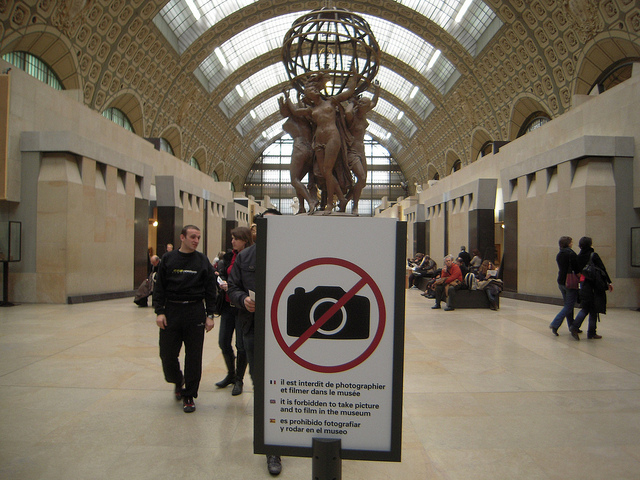
“No Photos” No More?

May 20 2013 @ 3:00pm
dish_museumphoto
Taking pictures in museums may violate copyright, but the practice is becoming integral to art appreciation:
As a culture, we increasingly communicate in images. Twenty years ago, a museumgoer might have discussed an interesting work of art with friends over dinner. Today, that person is more likely to take a picture of it and upload it to Facebook—such as New York magazine critic Jerry Saltz, who, earlier this year, posted a photo of himself hamming it up in front of a Marcel Duchamp at the Philadelphia Museum of Art. Or perhaps that museumgoer might remix his or her photo with other visual elements and transform it into something new. Every day, users on image-sharing sites such as Tumblr create their own diptychs, collages, and themed galleries devoted to everything from ugly Renaissance babies to Brutalist architecture.
This transformation in the way in which people digest visual stimuli—not to mention the rest of the world around them—is something that Harvard theoretician Lawrence Lessig has described as a shift from “read-only” culture (in which a passive viewer looks upon a work of art) to “read-write” culture (in which the viewer actively participates in a recreation of it). The first step toward recreating a work of art, for most people, is to photograph it, which, ultimately, isn’t all that different from the time-honored tradition of sketching.
Which is why the ban on photography directly undermines the very point of an art gallery. You have to make it non-flash, and you have to be discreet. But making rules for it should not be beyond most museums.
(Photo: Bernard Hasquenoph / Louvre pour tous )